Website: Donaldson Company, Inc., is a leading worldwide provider of filtration systems and replacement parts. Founded in 1915, Donaldson is committed to satisfying customer needs for filtration solutions through innovative research and development. Donaldson serves customers in the industrial and engine markets, including dust collection, power generation, specialty filtration, compressed air purification, off-road equipment, industrial compressors, heavy trucks and light vehicles.
 |
| I liked the little crane they had. |
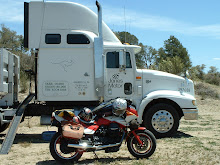
There is a truckstop near the town of Belmont, close to Lake Joy Campground, we left the trailer there and bobtailed to the campground.. We attended this rally in 2006 and knew we could easily get the bobtail in there. Found a spot about noon on Friday, 3 August and unloaded the bike and settled in. Went for a ride to Mineral Point - an interesting town! Found a Brew Pub, then explored some of the local country roads and back to the campground by 5pm for dinner. Included in the rally fee is unlimited beer! There is a refrigerated trailer with six beer taps on the exterior. Quite the attraction! Great food as well and always local Wisconsin cheese to sample.
 |
| No trouble finding our 'tent'! |
From www.DriftlessWisconsin.com Driftless Wisconsin was spared being flattened by the last glaciers that bulldozed their way across the Midwest more than 10,000 years ago. Which is to say, it was spared from being ordinary. It is a beautiful area.
Saturday Jim and I left early as we had a circuit planned. Headed east, then north. As we had been driving to Wisconsin in the truck I noticed many barn quilts. I have seen these often in Kentucky, Michigan and eastern states, but had never had the camera ready to take photos. We crossed the Quilt Trail a few times and being on the bike, we could stop on the side of the road for photos.

Internet: The history of the American Barn Quilt can be traced back almost 300 years to the arrival of immigrants from the central regions of Europe; Germany, Austria and the Netherlands.
It is widely believed that barn painting/quilting originated in Pennsylvania with these immigrants and then spread to much of the New England and Midwestern states. Paint was very expensive in those days and painting a decorative and distinctive quilt pattern on their barns was a wonderful way of allowing for decoration. It also became an excellent way for travellers to find particular families or cross roads as towns people would just tell them which pattern to look for.
Paint became less costly around the 1830 to 1840's and at this point barn painting/decorating became an actual trade with specialized artisans. These artists combined many folk designs as well as specific geometric patterns from quilt squares.
Decorating barns with colorful designs and quilt squares peaked by the beginning of the 20th century and slowly gave way to a more pragmatic form of barn painting; advertisement. Gone were the colourful quilts and in their place came the paid ads for Red Man Chewing Tobacco, Ceresota Flour, and Mail Pouch: A nostalgic part of the history of American barns in their own right.
Today barn quilts have become popular again with more and more becoming visible. Quilt Trails have been developed in many states.
The quilts can be put on any type of building, from houses, garages, sheds or just mounted on two posts and displayed in the yard or a park.
This simple idea has spread to 29 states and to Canada, and the Quilt Trails continue to grow. Over 3000 quilts are part of organized trails; dozens more are scattered through the countryside waiting to be discovered.

Stopped at Luckenbooth Cafe in Black Earth for a break, on the western side of Madison, Capital of Wisconsin Then crossed the Wisconsin River.
Internet: The first documented exploration of the Wisconsin River by Europeans took place in 1673, when Jacques Marquette and Louis Joliet of France canoed from Lake Michigan up the Fox River until reaching the present-day site of Portage in early June. At this location the Wisconsin and Fox rivers are only 2 miles (3.2 km) distant, so the explorers could portage from the Fox to the Wisconsin River. They then continued downstream 200 miles (320 km) to the Wisconsin's mouth, entering the Mississippi on June 17. Other explorers and traders would follow the same route, and for the next 150 years the Wisconsin and Fox rivers, collectively known as the Fox-Wisconsin Waterway, formed a major transportation route between the Great Lakes and the Mississippi River.
Rode along the north side of the Wisconsin River, west to where it meets the Mississippi River and state line to Minnesota. At this time the predicted scattered thunderstorms found us. Thunder and lightening and a downpour. We waited for awhile, then put on rain gear and made it to Potosi and the National Brewery Museum.

Website: Welcome to the National Brewery Museum™ and Brewery Research Library. The museum is located in the Potosi Brewery building which was built in 1852 and restored in 2008. Here you will find over 100 exhibits of brewery history from American breweries no longer in business.
The National Brewery Museum™ is a member’s museum and the items on exhibition are on-loan from our members. Our members belong to the American Breweriana Association, Inc. (ABA) and the goals of the ABA are to restore and preserve brewery history and advertising, appreciate the challenges brewery pioneers overcame, and to promote friendship.
View American brewery artifacts, learn how beer is made and how beer influenced society, have lunch or dinner at the brewery restaurant, and check out the gift shop.

We spent almost two hours there - it was interesting. With museum admission visitors received a free Potosi Beer. There was more thunder and lightening during this time, but the storms had passed when we were ready to leave and head back to the rally.
After dinner and the awards, a group went to Mineral Point for ice cream - the Red Rooster Café. The staff were wearing the t-shirt. I had to order Figgy Hobbin. It is a Cornish dessert: A plain pastry sweetened with raisins. In Cornwall raisins and currants were often referred to as figs, hence the name 'Figgie Hobbin'. Cornish Pasties are popular in this region as well.
 |
| Red Rooster Cafe, Mineral Point, Wisconsin. |


 From tourist brochure: Mineral Point, one of Wisconsin's treasures.
Because the area was untouched by glaciers, minerals were easily accessible at the surface. Prospectors and adventurers swarmed the hills and lived in crude shelters that resembled badger holes. (Wisconsin would later adopt the name The Badger State as its nickname.)
In 1830s, news of rich deposits of lead reached Cornwall, England. Cornish miners and their families started arriving in Mineral Point. These early immigrants possessed advanced mining skills as well as expertise in stone building construction. Their legacy is reflected in a remarkable inventory of mid-nineteenth century architecture.
Mineral Point was an important centre of early Wisconsin government. In 1829 it became the county seat. At that time Mineral Point had a population greater than that of Milwaukee and Chicago combined. Mineral Point was a bustling, growing city that attracted many politically significant and influential people.
Historians say that for over a decade lead mining controlled Territorial Wisconsin. Then in 1849 the California gold rush resulted in an exodus from the young city. 260 people departed in one day alone, and Mineral Point fell into a state of depression.
1935 marked the beginning of a preservation movement. Artists, craftspeople, and preservationists began restoring more and more historic building.
In 1971 Mineral Point became the first Wisconsin city to be listed on the National Register of Historic Places.
I enjoyed Mineral Point - a lot of interesting history.
Not sure of the final count of attendees at the rally: 150+ people. Jim and I left early Sunday afternoon to be ready to deliver in Le Sueur, Minnesota Monday morning.

We headed north, then west on country roads into Minnesota. Went through the Amish settled areas and the dash cam photographed an Amish buggy. A bit of a dilemma because Amish people don't like to be photographed, but it is an interesting photo. Not sure if I am being disrespectful by posting it because their faces can not be seen and I have seen many photos of them closer up than this in brochures. (A few days later, seeing a postcard of people in an Amish buggy tipped me.)
Website: The first Amish came to western Wisconsin in the early 1970s. The Amish culture is based on traditional values and practices that date back to the 16th century. They are known for their simple living, plain dress, and resistance to modern conveniences (such as electricity). Their horse-drawn buggies are a common site on our country roads.
The filtration system we had went to Cambria.
Wikipedia: Cambria is the sole producer of quartz surfaces in the United States. Primary for use as kitchen counter tops, it is used in a similar manner as granite, except that it is not porous thus requires no periodic sealing. The look of any quartz countertop compares to granite in that the colours are deep and consistent.
The process of creating the countertops is different than granite, in that it is an engineered product, consisting of about 90% quartz and 10% epoxy binder. An engineered product that requires no sealer has the advantage in that require no harsh chemicals to seal, nor do they emit harmful chemicals into the air, making them potentially more environmentally friendly.
In Le Sueur there was a banner advertising the "GIANT Festival", and the Jolly Green Giant billboard greeted us.
Note: The community is known locally as the "Valley of the Jolly Green Giant". A large billboard, with the caption "Welcome to the Valley" and Green Giant logo, remains even after the company and Green Giant label were bought by Pillsbury in 1979. Now the Green Giant label is owned by General Mills and is canned in Montgomery, Minnesota.
Jim found a load to Florida, but details were somewhat lacking. It was a 9 foot wide load, and the exact dimensions are required to order permits. We waited two hours for confirmation we had the load, but dimensions were not in the email. It was 200 miles (300 kms) deadhead, so we started south. Two hours later we received the dimensions - it was 11 foot wide and no increase in revenue. So Jim told them to forget it. Dishonest agents do that - wait until the driver has invested time and money into the load, then come clean with the details expecting the driver to just say "OK". Then the agent keeps the extra revenue. We haven't had that happen for a long time.
We were on the side of the road somewhere in Iowa, looking for another load. Finding nothing suitable, we continued south and parked at a service station in Bancroft, Iowa. Looked for a load until after 6pm and found nothing.
Bancroft is a small rural support town, population less than 800. I went for a walk around town while Jim was looking for a load. I found a garage with a quilt pattern!

And the Main Street Pub and Grill. The Pub is an old department store converted. It had a beautiful tin ceiling and museum like cases of old store items.
Website: Take a step back in time at the Main Street Pub & Grill in Bancroft, Iowa! We have a full bar and menu to satisfy your taste. Feel free to stroll around the large bar, the dining room, and our party room - there's so much to see and do! Walk in past the old fashioned street lights (indoors!) and stroll down the indoor street representing Bancroft stores from 1900.


After lunch the next day, Jim found a load (630 miles / 1000 kms away) going to Florida. So we started heading east - it didn't load until Thursday. There would not be a profit on this run, but we had some things to take care of at the house.
 |
| Solsberry, Indiana to Sanford, Florida. |
Arrived in Daytona Friday evening, Jim delivered in Sanford on Monday morning. We had a week at the house - always a lot to do, we were busy all the time and didn't get to visit with anyone.
Headed to Perry, Florida and loaded Friday before lunch on 17 August. We had 15 steel concrete forms used for building bridges and highway retaining walls for LUNDA Construction. Jim was told there were 80 truck loads of these forms.
 |
| Perry, Florida to Black River Falls, Wisconsin. |
 |
| The Black River near the town of Black River Falls, Wisconsin. |
We found the mural of LUNDA Construction which was where we were delivering. Obviously a major employer in the town because there is LUNDA Sports & Recreation Centre. The mural shows some of the bridge constructions they have done in the USA.


Millis Transfer have been in business for many years and their headquarters is in Black River Falls. We see their trucks regularly on the highway.

Being a Sunday afternoon not many businesses were open, but we perused a couple of antique stores, and spent time talking to a lady who has the Buzz and Brew shop. They have bee keeping supplies and wine and beer home brewing. She was fun and told us a lot about the town and area.
Jim noticed three of the five bars in the two blocks were open. First stop was Murphy's Pub, only a few people in there and they were all native Americans (Ho-Chunk) and lots of fun. We were introduced to the bar fly swatters. The lady talking to us kept swatting the flies on the bar. There were other swatters at the bar as well. We both had Wisconsin beers there, Jim had Murphy's Ale and I had New Glaris Spotted Cow.
On to Cozy Corner bar. More fly swatters on the bar! I had Leinenkugel Summer Shandy and Jim had a Leinenkugel Red, both Wisconsin brewed.

Then across the street to Laura's Brick House for burgers and to sample the local brewery - Sand Creek beers. I had Golden Ale and Jim had Oscars Chocolate Oatmeal Stout and Wild Ride IPA.

Currently Sand Creek produces 29 different products. They specialize in premium craft brewed lagers and ales and hard lemonade.
Monday 20 August, we delivered at LUNDA Construction:
Website: Founded in 1938, Lunda Construction Company has maintained its headquarters in Black River Falls, Wisconsin and has continued to pursue and build transportation projects. In those early years, small crews built small box culverts and bridges. Lunda saw its largest growth starting in 1956 with the Interstate Highway Program.
There were eight trucks ahead of us at 7am and when we left about 9am, about twenty after us - it was going to be a busy day there! We headed to Minneapolis and loaded a Caterpiller roller.
On Wednesday 22 August we delivered the CAT roller to Toromont CAT - Sales and Rentals in Peterborough, Ontario.
The next load was for GM Canada. The address we were give for loading turned out to be the 'billing address' not the shipping address and we spent two hours in the driveway of an office building. The only deliveries they receive are mail and for the cafeteria. To load at the GM Canada plant we required a pick up number and dock number, took two hours to get that informatuion. Then Jim had to back out of the office parking lot.
 |
| The GM Canada shipment. |
Website: GM Assembly Oshawa Canada: The Oshawa Assembly Plant has two production lines; The Flex Line and The Consolidated Line. The flex line builds the Chevrolet Camaro, Camaro Convertible, Camaro ZL1 and the Buick Regal, Regal eAssist and Regal GS. The consolidated line assembles the Chevrolet Impala and Equinox. Oshawa Assembly Plant is the future home of the all-new 2013 Cadillac XTS.
Our load was one stamp table and we delivered it the next morning near Detroit, Michigan to a shipping company where it will be sent to South America.
The next morning we loaded at another shipping company - two crates of Chrysler factory parts to go on a ship in Jacksonville, Florida for export Chrysler Venezuela. We had almost half the trailer empty, and we got the OK to put on an LTL (Less Than Truckload). Found two small transformers in Sharon, Pennsylvania. We hurried over there and barely made the cut off shipping time of 3pm.
After loading we could relax, it was an easy run to Florida and we had all weekend to get there. That was until the transmission was destroyed in the truck. Jim said, "Do you hear a noise?" "Yes, a high pitched squeal." Next thing there was a whole lot of crunching and rattling! He managed to get totally off the Interstate highway and onto the shoulder. It was obvious we had lost all the transmission oil, it was on the back of the cab, underneath and the sides of the trailer and the load.

It was after 6pm by the time we got to the shop, so too late to look for and order parts. The mechanic did have the transmission plate off before we left there. The forward gear was completely bare of teeth, the middle one was a pretty blue colour from being extremely hot, and the third one had more than half the teeth missing. Jim wanted a remanufactured replacement transmission and also a new clutch. The clutch had been making noises almost since it was put in and it was easier and cheaper to replace it while the transmission was out.
We packed an overnight bag and the shop drove us 5 miles back to the truckstop and to the motel near it. The next morning Hunters Truck Repair came and got us and took us back to the truck. We unloaded the motorbike and Jim talked to the mechanics about options and we also explained that we had a time sensitive load on the trailer. The three shipments were for export and there is a deadline to have the freight at the port and ready for each freighter. Their estimate to have us out was between Wednesday and Friday depending on the availability of a transmission, which would not be known until Monday morning. We sweated a bit - to have another driver called in to deliver our trailer in Florida and bring it back to us would cost us a lot of money over and above the break down and repair.
 |
| Emlenton Bridge, part of Interstate Highway 80. |
Wikipedia: The Allegheny River is a principal tributary of the Ohio River; it joins with the Monongahela River to form the Ohio River at the "Point" of Point State Park in Downtown Pittsburgh, Pennsylvania. The Allegheny River is, by volume, the main headstream of the Ohio River. The Allegheny River has eight locks and dams.
It was interesting to be on the road below Interstate Highway 80 - we had been over the Emlenton Bridge that crosses the Alleghany River - I had no idea it was this impressive underneath.
We had a mid afternoon snack in Clarion and and stopped in the town of Knox and enjoyed the late afternoon activities of Horsethief Days - the day activies were packing up and the music and food was starting. We had seen many antique cars and tractors in our travels apparently coming and going to Knox.
Website: The 51st Annual Knox Horsethief Days! Come out and enjoy the softball tournament, yard sale, tractor races, sidewalk sale, car cruise, live entertainment, community picnic, and parade.
The event got its name because at one time Sebastian "Boss" Buck, the most notorious horse thief in US history, reportedly had his headquarters and residence near Knox Borough.
Sunday we got up early and were on the road at 6.45am headed to Lisbon, Ohio for the monthly Ohio Moto Guzzi Breakfast. Jim planned a scenic route on secondary roads about 90 miles (150 kms). We rode for an hour and because it was a bit cool, we stopped for a warm up coffee and also found out we had only gone 30 miles! We were 45 minutes late getting to the restaurant. About fifteen bikes there and several people we knew.
 |
| Ohio Moto Guzzi breakfast. |

In nearby Leetonia are Coke Ovens, which are part of the steel making process the area was once a major producer of.
The Cherry Valley Coke Ovens consisted of 200 coke ovens built by the Leetonia Iron and Coal Company around 1866. The function of the "beehive" coke ovens was to purify coal and turn it into coke. The coke was burned in furnaces that produced iron and steel.
The site was placed on the National Register of Historic Places in 1993. An Ohio Historical Marker was added in 1999. The site represents the largest remaining site of beehive coke ovens in North America.


A motorcycle ride through farmland and small towns to Marks Landing restaurant on a lake for a late lunch and drinks (we had a late breakfast!). Afterwards we said our good-byes and Jim and I headed back to the motel in Emlenton. That was a fun day!
We were at Hunters Truck Repair at 8am Monday morning. They located a remanufactured transmission in Columbus, Ohio. It would be delivered about noon on Tuesday, the truck was already disassembled and ready for the transmission to go in after it was delivered. Estimated time for completion was Tuesday evening.
Monday afternoon we went to Foxburg to the Winery. Very nice wine and well marketed, I have seen it before. We followed the Allegheny River for awhile and found Riverstone Lounge and Grill in Parker.
.JPG)
Wikipedia: Parker is sometimes referred to as the "Smallest City in the USA". Parker was incorporated as a city on March 1, 1873 by special state legislation in the midst of the northwestern Pennsylvania oil boom. Residents assumed that Parker would quickly become a major population centre, and, at the height of the oil boom, the population of Parker grew to over 20,000. The boom quickly went bust, however, and by the 1880s the "city" returned to its historic, small village size, and a population of approximately 1,000.
Riverstone decor was impressive. There was no one else in the bar, so the bar attendant took us on a small tour. It was an old warehouse beside the river - exposed 'old' bricks and beams. Large quilts on the walls, a black bear, etc. A lot to look at.
.JPG)
.JPG)
It started raining, so we headed back to the motel early, it rained the rest of the afternoon. Tuesday morning we went for a motorcycle ride to Oil City. We have been there before but only in the truck and don't see anything. It is an interesting city and has some well preserved old buildings. The city is on both sides of Oil Creek, so there are many bridges connecting and buildings are on the side of hills.
Wikipedia: Oil City is a city in Venango County, Pennsylvania that is known in the initial exploration and development of the petroleum industry. After the first oil wells were drilled nearby in the 1850s, Oil City became central in the petroleum industry while hosting headquarters for the Pennzoil, Quaker State, and Wolf's Head motor oil companies.
Oil City is located at the confluence of the Allegheny River and Oil Creek. Barges were used to transport the oil down Oil Creek and into Oil City, where it was transported to steamboats or bulk barges to continue on to Pittsburgh and other locations.
Jim found a short cut from Cranberry to Emlenton. The map showed that it was not a continuous line - likely not bitumen.
We traversed two steep mountains on a gravel road; very loose gravel with washouts, puddles and branches.


It had several anxious moments and something we had not encountered before - oiled road!

For about 50 metres eitherside of a driveway, probably spread by the owner in the hope of keeping the dust down. I researched and found "individuals in rural areas sometimes pour waste motor oil onto their driveways for dust control--which is unfortunate, because the oil often contains hazardous metals and other toxic chemicals that are washed into the environment by rain." Interesting. Luckily more gravel travel wore the oil off the tyres before we hit bitumen again.
We spent some time each day in the town of Emlenton. The truckstop and motel are two miles from the town. It has many historic buildings.
Website: Emlenton is a recreational and sportsman destination. Small town American charm and history abound.
 |
| The repair bill! |
At 8pm on Tuesday, the repairs: new clutch, engine mounts, a couple of guages fixed, new main seal, transmission oil cooler and lines, a resurfaced fly wheel were done. The truck was back together and test run. We loaded the bike, hooked the trailer - it was 10pm by the time we got rolling. We would make our deliveries in Florida.
Though delivering Thursday was a frustrating day! Our first stop - a small transformer went to an air freight forwarder near Jacksonville airport. They would not unload a stepdeck trailer because it was not dock height - 7 inches lower than their dock! We have always had a low trailer - household, tradeshows and stepdecks - NEVER had anyone say they could not unload it! The shipment was refused. We stayed in the parking lot and made phone calls. We sat their for 3 1/2 hours. They were told by their bosses that we had to be unloaded.
Of course they were determined to make a big deal about it - spinning the forklift wheels on the trailer, and breaking the pallet - it was way beyond their skill level. After watching for 15 minutes, Jim suggested they get the pallet jack under the pallet, move it to the end of the trailer and pick it up with the forklift. That took five minutes.
 |
| Port of Jacksonville, Florida. |
Friday, 31 August loading at Fort Stewart, Georgia going to Louisiana. Ex-Hurricane Isaac was still dumping huge amounts of rain on the state.
My flights are booked for Australia. Arrive Brisbane on 17 September. :-)