Thursday, August 1, 2013

Vol 17 No 5 - 31 July, 2013


On 29 June our way south to Florida we parked the truck at a truckstop near Jackson, Georgia Saturday afternoon and took the bike off the truck. We had not had the opportunity to visit our friends – Diane and Gary Barber for a few years.  We go through Atlanta but usually have no spare time.  An overnight visit and catch up with Gary, Diane, Kathy, Ian and Lennon was very enjoyable.  Back to the truck by noon Sunday.

Delivered at GAF Materials in Tampa, Florida on Monday morning 1 July then to Daytona Beach.
It was the lead up to the Fourth of July celebrations - a busy time.  Jim worked on the exhaust system on the truck – there was a leak, and the generator was not charging, he spent one day plus three mornings working on the truck.

Wednesday evening 3 July was the annual BBQ, Blues and Brews on Main Street.  We walked down for a look.  The staging for the Budweiser Brewery Clydesdales was on the way.  They are spectacular, a crowd pleaser and get a lot of attention. 

Budweiser Clydesdale rigs in Daytona Beach.

Budweiser Clydesdale's on Main Street.
 Main Street was closed to vehicular traffic, it was lined with food and drink vendors.  The Pig Stand BBQ restaurant had a truck and trailer that looked like a barbeque grill – that was fun. Lots of old cars on display.  Live bands at Froggy's, Full Moon Saloon and Main Street Station.


A good crowd of people attended, great food to choose from and dancing in the street.

Thursday was 4 July at Bob and Wendy Stantons for a traditional American celebratory cook-out. Always a fun time with them and their friends (and their pool).

That evening we walked to the Bandshell for a free concert by the Alter-Eagles, an Eagles tribute band – good music and spectacular Fourth of July fireworks off the Pier.


Alter Eagles Concert and fireworks at the Bandshell.

Friday we met Tim and Helena, Derek and Cindy and Mark in New Smyrna Beach and rode the bikes down to the Cocoa Beach Brewery for some new beer brews.  Cocoa Beach is 130 kms (80 miles) south from Daytona Beach.

Back north to Cape Canaveral for lunch at Grills Seafood and Tiki Bar - great food and atmosphere.  It was funny to hear the horn of a cruise ship and look out the window as Enchantment of the Seas cruised by.

Wikipedia: Port Canaveral is a cruise, cargo and naval port.  It is one of the busiest cruise ports in the world.  As a deep water cargo port, it has a high volume of traffic.  Common cargo includes cement, petroleum and aggregate.  The channel is about 13 m (44 feet) deep.   The channel leading to the port is 120 m (400 feet) wide and 5.6 km (3.5 miles) long.  Carnival, Disney, Norwegian and Royal Caribbean International are some of the cruise lines which dock at the six cruise terminals.  Ten ships on average, enter the port each day.


Photo of Tim and Helena’s moto guzzi converts – our shiftless friends!  Tim has given the Silver Bullet a paint job and got all the lights working.

Tim and Helena's moto guzzi converts.
Back in Daytona Beach Saturday evening we headed back to the Bandshell for the Caribbean Chillers concert.
Website: The Caribbean Chillers show is an “authentic” recreation of what you’ll see, hear, and experience at a Jimmy Buffet Concert.  One of the best Tropical Rockin’ Party Bands in the business. An Orlando, Florida based band.

Caribbean Chillers at the Bandshell.
They were loads of fun – and yes. authentic Jimmy Buffet music!  Bob, Wendy and some of their friends were there also.  And more fireworks!!

Because businesses closed for the holiday weekend, we stayed for Monday, to tend to business and Jim could finish working on the truck.  We left Daytona Beach very early on Tuesday morning to load at Georgia Port Authority Garden City Terminal (Savannah): is the fourth largest container port in the United States.


We had one heavy duty military transporter truck and delivered it to the Red River Army Depot just west of Texarkana, Texas on Thursday morning and reloaded two army humvees at the same place.  That was nice – 0 deadhead!  This facility has acres of military vehicles.

Red River Army Depot repairs, rebuilds, overhauls, and converts the Army’s light tracked combat vehicle fleet. The facility has over 1,000,000 square feet (93,000 m2) of storage capacity.  RRAD was activated in 1941 to create an ammunition storage facility.

Military vehicle from Georgia Ports to Red River, Texas.
Red River, Texas to Arden Hills, Minnesota - humvees.
It was an easy drive to Minnesota and we could not deliver until Monday morning.  We parked at a truckstop in Rogers, north west of Minneapolis on Saturday morning and unloaded the motorbike.  There had been heavy rain during the night and morning but had cleared.  Saturday afternoon we did some exploring, it was a new area for us.

Doing a few bits of business locally - Jim needed new work boots, there were a few places nearby to look at.  Eventually found a suitable pair at Cabela’s.  There are 40 Cabela’s Stores in the US and Canada. (41 with the newest one under construction in Buffalo, NY.)

Internet: Cabela’s Incorporated is a direct marketer and specialty retailer of hunting, fishing, camping and related outdoor recreation merchandise. Cabela’s had a distinctive look to their retail operations, a look which turns them into tourist attractions as well as retail stores.  The stores are more like cavernous showrooms, bringing the outdoors inside.  They feature museum quality displays of taxidermied wildlife, large aquariums, indoor mountains, and archery ranges.  Also a restaurant and travel agency.

Each store is similar, but some have different features.  It is a great place to take foreign visitors to see North American wildlife!

Afterwards we went for a ride with no destination in mind for the afternoon.


South Central Minnesota in farming land, corn mostly, with many rivers and waterways that run into the Minnesota River.  It is a tributary of the Mississippi River approximately 534 km (332 miles) long.  The river valley is notable as the origin and centre of the canning industry in Minnesota.

Bar in Elk River, Minnesota.
Many interesting old towns, a whole lot of antique shops.  Stopped in Delano, a city situated along the South Fork of the Crow River.  Had lunch and beers at Dave’s Town Club.  Then north to the city of Elk River, situated at the confluence of the Mississippi and Elk Rivers.

Had dinner in Rogers at Minnie’s Diner and I had their famous Minneapple Pie: individual deep fried apple pie with cinnamon ice cream.  Yes, it was good.

Jim had seen a liquor store near the truckstop, so on our way back we stopped to check it out.  A ‘Dan Murphy’ sized store, it was interesting to see the Minnesota beer and wine available.  Jim settled on a 12 pack of Grain Belt, a Minnesota brew.

Wikipedia:  Grain Belt beer was originally produced by the Minneapolis Brewing Company in 1891, it quickly became the company’s flagship product.  The name refers to the “Grain Belt” of the American Midwest where much of the world’s supply of barley, corn, soybeans and other grains are produced.


New and popular Cupcake Wine display.


Sunday morning we started much earlier, we had a destination - New Ulm about 130 kms (80 miles) south west.  All back roads that required several map stops.  Through the town of Buffalo, Minnesota beside Lake Buffalo.  We rode around it and I took some photos of some of the painted buffalo statues we saw. They were lovely to see and a town promotion.  It is an old resort town and we were interested because of Jim’s hometown of Buffalo, New York.  On Wikipedia I found:

The town of Buffalo is actually named after the carp-like fish that were once abundant in this region.
I wasn’t expecting that!!  (Why were there bison statues and not fish statues in the town???)
Hmmm: Ictiobus also known as buffalo fish, is a genus of freshwater fish common in the United States, but also found in Canada, Mexico and Guatemala.

And:
The bigmouth buffalo, the largest of the sucker family lives in lakes and rivers in most of Minnesota except the Lake Superior watershed.

There you go - interesting, eh?  :-)


Our first stop in New Ulm was the Schells Brewery and we arrived about 12 noon.  The brewery tours on a Sunday did not start until 1pm and were one hour duration.  We didn’t have the couple of hours to spare, so we looked through the museum and gift shop then went back to the town of New Ulm.

Another German town!

Tourist Brochure:  New Ulm was founded by two groups of German immigrants beginning in 1854, both looking to create ‘a utopian German community in the American wilderness’.  They sited their town on the natural terraces that occurred near the confluence of the Minnesota and Cottonwood Rivers.
In 1860 German immigrant August Schell paved the way for a 153 year old family tradition – the August Schell Brewing Company.  The oldest brewery in Minnesota and the second oldest family owned brewery in the nation. (Yuengling in Pennsylvania first).  Schell still specializes in brewing German style lagers.  In addition to the 18 craft beers that Schell produces, since 2002 they have adopted ‘Grain Belt’.


Seen on a t-shirt: ”In a town with 14,000 thirsty Germans, your beer had better be good.”

The city of New Ulm is beautiful, with many buildings restored and historic landmarks.  We rode around the central business district and through Goosetown - the official name for the area beside the river where early settlers had many domesticated geese that roamed the area.

Found a bar the Pub and Patio on Minnesota Street in New Ulm and did several samplings of Schells beer there.

Old Post Office, now Museum in New Ulm, Minnesota.
A very interesting place and we want to come back another time.

On the way back to the truck we stopped in Hutchison Main Street Sports Bar for lunch, then in Delano at Dave’s Town Club again.
340 miles on the bike for the day and a half in Minnesota.

Delivered the two humvees on Monday to the Arden Hills Army Training Site:
Internet: AHATS is a military training area under the control of the Minnesota National Guard.  Formally known as the Twin Cities Army Ammunitions Plant, the facility produced over 16.5 billion rounds of small-arms ammunition for World War II, the Korean War and Vietnam conflict.  AHATS is utilized for small unit military training.

From there 95 miles to Hewitt Boat Lifts and Docks in Nicollet and loaded modular dock parts.  Took four hours to load it.  Lots of small parts and we had three deliveries so they had to be together as much as possible and still be loaded correctly and safely.

Because lakes, rivers, ponds and waterways freeze in the northern part of the continent, docks and boats have to be taken out of the water otherwise they bend and break as the water freezes and expands around them.  The jetties and docks are pulled out before winter and replaced when the ice has thawed in Spring.  Many docks are aluminum and on pontoons and plastic wheels that ‘roll in’ for easy placement and removal.

The first delivery was in East Canton, Ohio on Wednesday morning, we got the next two off in Auburn, New York and Richfield Springs, New York on Thursday.  Didn't have too many problems, the plastic pontoons and decks started to squash and the load moved a little, but Jim put more straps on and a  brace, and it required constant checking.  We were pleased when all was delivered without mishap!

There was no loads that interested us in central New York, so we deadheaded about 300kms (200 miles) to St Catherine’s in Ontario, Canada.  Loaded empty auto parts racks on Friday and delivered them near Detroit at General Motors that afternoon.  

We wanted to work the weekend, but lined up to load on Sunday and sat Saturday in Perry, Michigan.  On a previous trip we discovered a small truckstop there and Café Sports bar and grill across the street.

Jim worked on the truck Saturday morning, then we walked into the town of Perry for a look in the afternoon.  Central Michigan is often referred to as the ‘palm of’ Michigan because the state of Michigan is shaped like a right hand mitten, so regions are relative to that.

Central Michigan’s economy is primarily agricultural and some automobile manufacturing.  Major crops include corn, sugar beets, and soy beans.

Early Sunday morning we headed north to Alma, Michigan and loaded pipe and delivered it the next morning in Freeborn, Minnesota at a place that builds grain hoppers and storage silos.

Pipe from Perry, Michigan to Freeborn, Minnesota.
There were no decent paying loads in the area, so we ended up sitting at a truckstop for two days.  Spent most of the time either Jim or I watching the load boards on the Internet.  So we did not take the bike off, because we would never have found a load if we were not searching for a load. Had to be on the phone seconds after a load was posted as we could see nine other empty stepdecks just in the truckstop we were in – all looking for loads.

One came up Wednesday about noon, so we hurried up to Sartell, Minnesota and loaded six pumps.  The Verso Paper Mill had closed.  In August 2012 there was a fatal explosion and fire and the plant was heavily damaged.  The Mill had been struggling for several years and required millions of dollars to rebuild it, so a hard decision was made to close it and put 260 people out work in the small city.  The equipment had been auctioned and we delivered the pumps to a company in Westlake, near Cleveland, Ohio where they will be refurbished.

Pumps from Minnesota to Ohio.
 Friday late morning we loaded at JLG Equipment in Orrville, Ohio.  A lovely town – headquarters of The Smucker Company.  Loaded two new telehandlers going to Buffalo, New York.


Orrville, Ohio to Buffalo, New York.
Arrived at Joe and Michele’s Friday evening, caught up with Bob Walters for a fish fry dinner.  Saturday was visiting, and also Jims High School Reunion picnic.  Maryvale High has an 'all class reunion' the last Saturday of July each year.  Classes that have a specific reunion have a separate dinner or get together the same weekend, so people can attend both functions.  The 'all classes' is great because people know others from sports, band, extra-curricular activities or the nearby neighbourhoods.  Jim has attended three years in a row, but this was my second picnic.  They have hot dogs and salads, etc. It was a nice afternoon, we went on the motorbike, just a few light showers of rain.

Jim Kostelney (ex-Maryvale High) his wife, Jan with Jim and I at reunion picnic.
Sunday was the Alden Car Show – the first year it was held there, 800 cars registered!  Rather huge and very impressive antique / historic cars.  Bob Walters had his 1957 Ford hard top convertible in the show.  


Bob Walters 1957 Ford.

Met other friends there as well – Rick and Marta Gorenflo.  Bob's car got a trophy, but now sure what category as we had to leave to have a cook-out with Jim’s family.

Lola in her cage.
I met my first real live Chinchilla!  Lola was a guest at the Casey house while we were there.  She belongs to Tyler's girlfriend, Lisa.  She is very high on the cute factor.  To me she looks like a cross between a squirrel, a rabbit and a rat….?? With short front legs like a T-Rex and big ears.  A small animal, it would fit in two hands.

She was fast and I didn't want to use the flash, but I got some photos, and stole one from Wikipedia.

Wikipedia: Chinchillas are crepuscular rodents, slightly larger and more robust that ground squirrels, native to the Andes Mountains in South America.  Today colonies in the wild remain only in Peru and Chile.  
The animal is named after the Chincha people of the Andes, who once wore its dense, velvet-like fur.

Most chinchillas currently used by the fur industry for clothing and accessories are farm-raised.

Chinchillas are popular pets but require special attention:

They require extensive exercise.  Their teeth need to be worn down as they grow continuously and can prevent them from eating if they become overgrown.

Chinchillas lack the ability to sweat, therefore, if temperatures get above 25 degrees C (80 degrees F), they could get overheated and may suffer from heat stroke. Chinchillas dissipate heat by routing blood to their large ears, so red ears signal overheating.
Photo stolen from Wikipedia, but looks a lot like Lola except for darker tail.
(This is why Lola was a guest - the recent heat wave resulted in Lola feinting from the heat where Lisa was living.) 
Chinchillas can be found in a variety of colours.  The only colour found in nature is standard grey.  The most common other colours are white, black velvet, beige, ebony, violet, and sapphire, and blends of these.

The animals instinctively clean their fur by taking dust baths, in which they roll around in special dust made of fine pumice. The dust gets into their fur and absorbs oil and dirt.  These baths are needed a few times a week.  Chinchillas do not bathe in water because the dense fur prevents air-drying, retaining moisture close to the skin, which can cause fungus growth or fur rot.  The thick fur resists parasites, such as fleas, and reduces dander, making chinchillas hypoallergenic.

Chinchillas eat and drink in very small amounts. In the wild, they eat and digest desert grasses, so cannot efficiently process fatty or high protein foods, or too many green plants.  A high quality, hay-based pellet and a constant supply of loose timothy hay will meet all of their dietary needs.

Lola was very entertaining, she has a large cage with lots of exercise equipment and a shoebox sized ‘bath’ of special dust bought from the pet shop her to roll around in.  Comical as she flipped and fluffed in it.


Monday morning we delivered the telehandlers to Skyworks Equipment Rental, Sales & Service in Buffalo.  

No loads lined up, so we sat the truckstop watching the internet load boards.  Joe and Michele were in the city and picked us up for lunch at Mighty Taco.  Tuesday we loaded wire baskets used for transporting auto parts.  These ones had been repaired and we took them to Karmax Heavy Stamping in Milton, Ontario.  Delivered, then reloaded damaged ones and took them back to the same place in Buffalo to be repaired.  That filled in the day and they paid well.

Wednesday morning back across the border to General Motors and loaded the empty automotive racks, the same type we loaded earlier in the month, and took them to GM in Romulus, Michigan again.

Saturday, June 29, 2013

Vol 17 No 4 - 29 June, 2013

1 and 2 June, we stayed at Joe and Michele’s near Attica, NY - Saturday and Sunday nights.
Monday, 3 June we delivered the one tank partial shipment that we picked up in Tennessee to Techniflo in Clarence Center, New York, near Buffalo.

Website: Techniflo services all manufacturing and service industries compressing and processing air, steam and gases of all industries.

Over to Hamilton, Ontario to Hitachi Construction Truck Manufacturing.  This company makes the very  large dump trucks like the ones used in mining.

My camera was handy when we drove over the Niagara River at Lewiston, NY and I took some photos of the Welland Canal and a lock, the hydroelectricity plant and Niagara Falls from the highway.  Been over this highway a hundred times but never think to take photos or learn about the area.

Internet:  The Welland Canal is part of the St Lawrence Seaway and enables ships to ascend and descend the Niagara Escarpment and to bypass Niagara Falls.  Approximately 40,000,000 tonnes of cargo are carried through the Welland Canal annually by about 3,000 ocean and Great Lakes vessels.  The original canal and its successors allowed goods from Great Lakes ports of Detroit, Cleveland, and heavily industrialized areas of the US and Ontario to be shipped to the Port of Montreal or to Quebec City where they are reloaded onto ocean-going vessels for international shipping.
The canal extends 43 km (26 mile) from Port Colborne on Lake Erie to Port Weller / St Catherine’s on Lake Ontario, and has 8 locks.  The maximum permissible length of a ship in this canal is 225.5 metres (740 feet), maximum beam is 23.8 metres (78 feet).  It takes ships an average of eleven hours to traverse the entire length of the Welland Canal.


The mist from Niagara Falls and the City of Niagara Falls. 
Internet:  Niagara Falls is one of the natural wonders of the world, but did you know that the power behind Niagara Falls also helps generate electricity?  The US and Canada have shared the Niagara River’s water power – along with a commitment to preserve the beauty of the Falls.

The Niagara project, located about 4 ½ miles downstream from the Falls, consists of two main facilities, the Robert Moses Niagara Power Plant with 13 turbines, and the Lewiston Pump Generating Plant with 12 turbines.  In between the two plants is a forebay capable of holding about 740 million gallons of water.  Behind the Lewiston Plant a 1,900 acre reservoir holds additional water.

Water is diverted from the Niagara River – up to 375,000 gallons a second – and conveyed through conduits under the City of Niagara Falls to Lewiston.  From there, water flowing through the Robert Moses plant spins turbines that power generators, converting this mechanical energy into electrical energy.  At night, when electricity demand is low, the Lewiston units operate as pumps, transporting water from the forebay up to the plant’s reservoir.  During the daytime, when electricity use peaks, the Lewiston pumps are reversed and become generators, similar to those at the Moses plant.  In this way the water can be used to produce electricity twice, increasing production and efficiency.

To balance the need for power and desire to preserve the beauty of Niagara Falls, the US and Canada signed a treaty in 1950 that regulates the amount of water diverted for hydroelectricity production.  On average more than 200,000 cubic feet per second (cfs) of water flow from Lake Erie into the Niagara River.  The pact required that at least 100,000 cfs of water spill over the Falls during the daylight hours in the tourist season – April through October.  This flow may be cut in half at night during this period and at all times the rest of the year.

Monday afternoon we left the truck at Empire Truck Services in Buffalo for a check up and preventative maintenance.  We took the le mans off the truck and went back to Joe’s.  The remainder of the week was in preparation for the Western New York Moto Guzzi Rally.  I also attended Baillie’s softball game with Michele and her parents which was fun and the last one for the school year.

Tim and Helena Hewitt drove up from Florida to attend the rally and pick up the 1976 silver Moto Guzzi Convert.  Jim and I rode it to the rally last year and Jim sold it to Tim and Helena last October.
Rain started on Wednesday through to Friday.  Joe left with the pick up and trailer with rally tent and supplies on Wednesday afternoon.  Tim, Helena, Jimmy, Jim and I headed down on Friday morning.  Michele and Bailie came down Friday evening after Baillie’s school field trip.


Tim on his 'new' convert, Jimmy on Joe's eldorado, and Jim and I on "Stella" Stone with Helena in their pick up truck.  Stopped in Springville for a late breakfast and arrived mid afternoon at the campground.  Jim and I have been attending the WNY rally at the Westfield KOA campgrounds since 2006, each year we find something different to see or do as well as some things we do almost each year.

The vineyard campground was a quagmire after two plus days of soaking rain.  Friday evening dinner was Joe and Michele’s “saddlebag soup”, it was very tasty and perfect for the cold, damp, foggy evening.  Also hot dogs and Frank and Penny’s Buffalo wings.  And birthday cake for one of the kids celebrating.
A group made a trip to the new Southern Tier Brewery in Lakewood, NY.

Website:  In operation since late 2002, Southern Tier Brewing Company has grown to produce around 50,000 barrels of beer annually.  The hand crafted ales are now available in more than half of the US, as well as parts of Australia, Denmark, Japan, Philippines, Singapore, Ontario, British Columbia, and the United Kingdom. 
The brewery started an expansion in 2010, a larger brewing capacity and high-tech bottling line that fills, caps and labels 10,000 bottles per hour.

Tim and Helena Hewitt with the Silver Bullet moto guzzi convert.

Guzzi group at Johnson's Winery in Westfield, NY.


Joe, Lesley, Jim and Jimmy "Joe Faces".
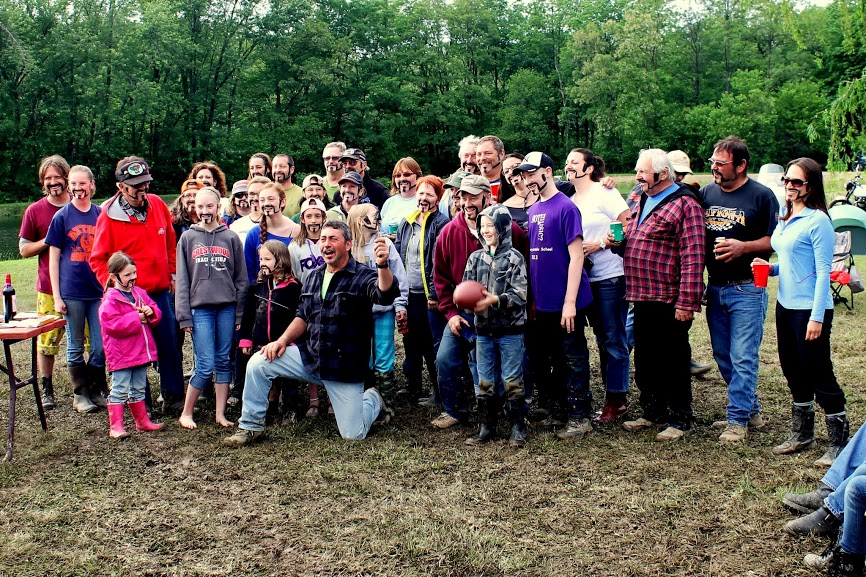
Saturday evening was the Rally dinner and awards.  Joe is the Western New York Moto Guzzi  Representative and he conducts the awards.  Before the awards there was a slow procession to the Blake/Poole camp.  Jim and Jimmy had an idea to play a trick on Joe.  He has a ‘man-scape’ moustache/beard that they tease him about.  They wanted to have lots of people sporting a “Joe Face”.  Lissy and Rob painted about 30 faces.  As people were gathering for the awards we all walked up the hill towards Joe.  It was hilarious!  Lots of photos taken, most people left the paint on for the rest of the evening.  Luckily it washed off easily!

Michele and Baillie.

The group of "Joe Faces" (photo stolen from Lissy Poole)
The clouds cleared to produce a beautiful sunset and we did the usual hike to the cliffs along Lake Erie to watch and take some photos.


The sun was out and getting warmer on Sunday morning for the pack and clean up, still muddy though.  Tim loaded the convert and he and Helena headed off to Florida.  The big tents, cooking and camping gear were packed up by 11am and we had breakfast at the Barcelona Café, then back to Attica to unload the trailer and pick up and clean everything.  Exhausted, but lots of laughs and good memories.  Joe thought attendance would be down because the Virginia Rally was the same weekend and unfavourable weather forecast, but 112 adults registered and 13 children, so it was close to the previous years.

Jim and I headed to Buffalo on the le mans Monday morning to get the truck.  It didn't need much and should make it to 1,000,000 miles (1,609,000 kms) we hope to reach in the next few months.

Jim loaded the le mans and we went to the truck stop.   Jimmy's truck was getting suspension work done.  Joe bought him in and all our gear in the car.  We met up at the truckstop for our goodbyes.

Tuesday afternoon we loaded and tarped in Cortland, NY at Pyrotek, 13 skids of parts for a trough system in aluminium production.
Pyrotech Website:  In the Global aluminium industry, Pyrotek is a recognised world-wide leader for equipment, consumables and consulting related to the refining, melting, processing and casting of molten aluminium.

Headed south to Foley, Alabama and delivered on Thursday at Vulcan Aluminium.  A new construction extending their factory.  This division makes the aluminium street signs from recycled aluminium.

Over to Pascagoula, Mississippi to load, but when we got there we found out the load had been picked up the day before.  Someone forgot to let our broker know that piece of information.  We found a replacement load for the next day in Hattiesburg, Mississippi.  Loaded and tarped that one on Friday morning at Loresco International, manufacturers of carbon backfill products for the catholdic protection and electrical grounding industries.  (??)  Whether the task is to control corrosion or to enhance electrical grounding capabilities, Loresco offers an extensive line of products.

Our load was 11 pallets of carbon backfill in bags and plastic pipe that had to be tarped.  The forklift driver explained the stuff we were hauling "it is mixed with the soil around the pipe to stop it from rusting".

It was a short haul to Missouri and we got to the nearest truckstop to our delivery about noon on Saturday and took the motorbike off the truck.  The truckstop at Kingdom City is in central Missouri and we had never done anything in that area before.  We headed to Fulton.  I was surprised to discover the Winston Churchill Museum and part of the Berlin Wall, also Civil War activity.

We rode around the Brick District, the historic downtown area – brick buildings and brick streets!
Brick streets were laid between 1910 and 1912, replacing the muddy clay streets and wooded sidewalks.  The combination of the brick streets and buildings constructed between 1870 and 1938 insure that the historic commercial centre of Fulton retains its historic feeling.


Westminster College in Fulton Missouri.
 Fulton has Westminster College, a private, residential, undergraduate college with a curriculum based on the liberal arts, (established in 1851).

These Columns are the only remains of the first Westminster Hall built in 1854 and destroyed by fire in 1909.

 In 1946 Sir Winston Churchill was the speaker for the commencement ceremony at Westminster College and delivered his "Iron Curtain" speech.  The National Churchill Museum is a national historic site located on campus and includes the Church of St Mary, Aldermanbury.  The church was in the City of London and first mentioned in 1181 and destroyed by the Great Fire of London in 1666, then rebuilt in stone by Sir Christopher Wren.  It was gutted by the Blitz in 1940, leaving only the walls standing. In 1966 these stones were transported to Fulton, Missouri by the residents of the town and the church was rebuilt on the grounds of Westminster College as a memorial to Winston Churchill.  The Churchill Museum is underneath the church.

 Churchill's grand daughter acquired eight segments of the Berlin Wall to create a sculpture entitled "Break Though".  The segments were from an area near the Bradenburg Gate and was frequented by artists and are covered in graffiti.  The sculpture is near the Church and was completed in 1990.

Church and the Berlin Wall.


There was a wedding in progress when we stopped at the Church on Saturday afternoon.

Fulton, Missouri is an interesting place! 

Internet: The Lewis and Clark Expedition, also known as the Corps of Discovery Expedition, was the first American expedition to cross what is now the western portion of the United States, departing in May 1804 from St Louis on the Mississippi River, making their way westward through the continental divide to the Pacific Coast. (And returned!!)

Their route in Missouri followed the Missouri River to its headwaters.  Jim and I followed parts of the Lewis and Clark Trail.  There are many state parks and trails, we crossed or followed the Katy Trail all weekend.

Wikipedia:  The Katy Trail is a recreational rail trail that runs 390 kms (240 miles) of the former Missouri-Kansas-Texas Railroad.  Running largely along the northern bank of the Missouri River, it is the country's longest Rails-to-Trails trail.  The trail is open for use by hikers, joggers, and cyclists year round from sunrise to sunset.  The nickname "Katy" comes from the phonetic pronunciation of "KT" in the railroad's abbreviated name MKT.  Sections of the Katy are also part of the Lewis and Clark National Historic Trail and the American Discovery Trail.


Our travels on Saturday afternoon took us to the city of Hermann, Missouri!
Website:  The City of Hermann was established in 1837 – a German Society settlement.  This quaint City is nestled along the banks of the Missouri River.  With original architecture, prize-winning wineries, a variety of shops, a strong industrial community and a host of ‘down home’ folks.  Hermann has been chosen several times for the title of Missouri’s most beautiful town.  The charm of old Germany and vineyards in the hills above town the centre of Missouri’s wine industry.


And the Tin Mill Brewery!  Saturday afternoon the place was busy – lots of tourists in town. 

Website:  Located in a landmark 100 year old tin mill in historic downtown Hermann is Tin Mill Brewing Company. Established in 2005, we brew all our beers using the old world German tradition of Krausening.  In this process we take beer that is almost finished fermenting and add a small amount of newly fermented beer.  This recharges the fermentation activity and adds natural carbonation.

We tasted the sample platter of six brews, all were good.

Late afternoon we headed back to the truck and experienced the worst storm we have ever ridden in!  High winds, torrential rain – very scary with zero visibility.  We wore rain gear and stayed mostly dry, but water on the road was deep, our feet and helmets were soaked.  Flash floods and damage all around.

Sunday, the stormy weather had cleared and we took a different route on the bike.  Went north to (the town of) Mexico for breakfast, then past where we had to deliver the next day.  Took little quiet roads along the Missouri River, past Jefferson City, the state capital of Missouri (named after Thomas Jefferson, the third President of the US).

Made a big circle and found our way back to Hermann.

The Gasconade County Courthouse in Hermann, sitting on a bluff with its dome gleaming and Old Glory flying in the breeze.  The Courthouse was heavily damaged by fire in 1905, the entire dome, the roof and a large portion of the second floor were destroyed.  When the building repairs were completed, the dome was not the same as the original specifications, but the building remains in almost its original condition.  The Courthouse was constructed of the finest materials available, including copper gutters and marble floors in the halls.

The Concert Hall and Barrel is the oldest continually operating tavern west of the Mississippi River.  Built in 1878, the Concert Hall was the hub of social life in early Hermann.  On the first floor a fine saloon was a gathering place for locals and a destination for fun-loving St Louisans.  The spacious upstairs hosted plays, lectures, dances and concerts.

First stop was the Hermann Wurst Haus for lunch.  The Wurstmeister offered free wurst tastings, some I remember – apple maple sausage, Caramelized Pear and Gorgonzola Bratwurst, Rueben Bratwurst, Andouille Sausage (hot Cajun style), Garlic and Butter Bratwurst.  For lunch we had their special – choice of two brats on a bed of sauerkraut and two sides (German potato salad and cauliflower/broccoli slaw).  Wurst Haus make over 40 varieties of Bratwurst and smoked sausage.

Also Missouri beer and wine tasting - I found a peach beer, “Peachie Wheat” and Jim had “Black Cabin Smoked” from Crown Valley Brewing in Sainte Genevieve, Missouri.

Back to the truck to load the bike before dark.  That was an interesting and enjoyable weekend.

Delivered near Clark, Missouri on Monday 17 June.  Part of the Keystone TransCananda Pipeline.
Internet:  The US portion of the Keystone Pipeline is 1,744 kms (1,084 miles) of new 760mm (30 inch) diameter pipeline in North Dakota, South Dakota, Nebraska, Missouri and Illinois.

Over to Clinton, Missouri to Tracker Marine Group:
Website:  In 1978, Bass Pro Shops’ founder Johnny Morris revolutionized the boating industry when he introduced the first fully rigged boat, motor and trailer package on the market.

Our load was two boats and trailers for a Bass Pro Shop near Toronto, Ontario and we delivered them on Wednesday morning, 19 June.

Back across the border and loaded in Silver Creek south of Buffalo in the afternoon at S.Howes Inc., they manufacture processing equipment.  After tarping, we left the truck on the side of the road and friends, Dave and Sandy Stroud picked us up and took us to their house for a visit and dinner.  We left early Thursday morning to deliver in Clinton, Iowa on Friday morning 21 June.

Clinton, Iowa is a Mississippi River town, our delivery was conveyors and hoppers for Nestle Purina Pet Food.

Trivia: Clinton, Iowa was named in 1894 in honour of DeWitt Clinton, two time governor of New York, as was Clinton, Missouri and probably other towns called "Clinton" in the USA.  He was one of the driving forces behind the construction of the Erie Canal.

To Chicago O’Hare Airport and loaded a CF34 aircraft engine Friday afternoon.  The engine had been flown in for Jordanian Airways for repairs.  Easy load, that is all we had on the trailer and tarped in a rain storm and headed out of the city.

Stopped in St Joseph, Missouri on Saturday afternoon.  A guzzi friend there had a replacement wheel for the Moto Guzzi G5 in Australia.  Ace has a shed full of parts.

Delivered the aircraft engine to GE in Arkansas City, Kansas on Monday morning. 
Website: GE Aviation is among the top aircraft engine suppliers and offers engines for the majority of commercial aircraft.

Tuesday morning for the next load, so we went to Fredonia, Kansas to wait.  Parked the rig behind a service station and walked ¾ mile to the town.

A small rural Kansas town, population about 2,500.  There were large grain silos on the way into town.  Monday afternoon it was very quiet.  It has a town square where the courthouse is, and shopping around the square. Old and neglected for the most part.  Not many stores open.  A town with no exciting history that I could find.  We eventually found a diner for lunch, but only one bar in town (we like to talk to locals) but it was closed on Mondays.  It was a fun and   interesting afternoon, and friendly - everyone said hello to us or waved.
Some Fredonia scenes:

Old cars in a vacant lot next to the Fredonia, KS Post Office.
The Gold Dust Hotel is a National Historic landmark which opened in 1885.

The Clock Tower was erected in the 1960s.  The clockworks from the 1886 courthouse
were saved and the enormous antique clockworks can be viewed through windows. 


Many buildings had painted murals depicting rural life.


Loaded Tuesday morning at Lefarge Cement Plant.  Lafarge website: Lafarge North America is the largest diversified supplier of construction materials in the US and Canada.  We produce and sell cement, ready-mixed concrete, gypsum wallboard, aggregates, asphalt, paving and construction, precast solutions and pipe products.  Our products are used in residential, commercial and public works construction.


Lafarge Fredonia Plant is a casualty of the 2008 Global Financial Crises.  The Plant had been running at a loss, so began closing down and moving its equipment to other Lafarge Plants across the USA.  Our load was all large metal chains.  We were unsure how the chains were Cement Plant equipment, they are used to absorb heat when mixing large batches of cement.  After many hours of continuous agitating they wear down to be thin links.  We saw several fences in Fredonia made from the worn out chains.  The wooden storage boxes were weathered and fragile, chains falling through the bottom and sides.  The boxes cracked when Jim strapped them.  A bit nervous about the whole load making it to Ohio!  A driver had gone in the day before to load and refused it.

Delivered on Wednesday 26 June at Lafarge in Paulding, Ohio – had no problems with the load, everything stayed in the containers.

Loaded and tarped machines in Cincinnati the next morning and delivered them in Henderson, Kentucky Friday morning and loaded roofing in Evansville, Indiana in the afternoon, a partial tarp. Henderson and Evansville are cities on either side of the Ohio River, we had a 15 mile deadhead.

The roofing does not deliver until Monday, 1 July so we had a day to fill in enroute - Nashville!


We had a fabulous Friday evening listening to music and having a few drinks in the city.  Walking past Roberts Western World was impossible.  It was early and there was a crowd, but still room to move.  Spent a couple of hours there listening to The Don Kelley Band rocking the place.  The best "Ghost Riders in the Sky" EVER!  There was a young guitar player the band were promoting - he was very good and played several solos.  When we wanted to eat there were long lines waiting to get into almost every bar and restaurant.

Greg Allman Bros Band was playing at the Ryman Auditorium. It was sold out and after the concert about 2,000 people joined the large crowd already on Broadway Street.  So many people!   We had never been to the Hard Rock Café in Nashville before, but this night it was almost empty.  There was no live band, just video screens and music.  We had a nice meal and had intended finding a place for more music, but it was much too crowded for us (and it was midnight), so we headed back to the truck.

Followers

Blog Archive